Rethinking construction: the Centre’s first MMC course
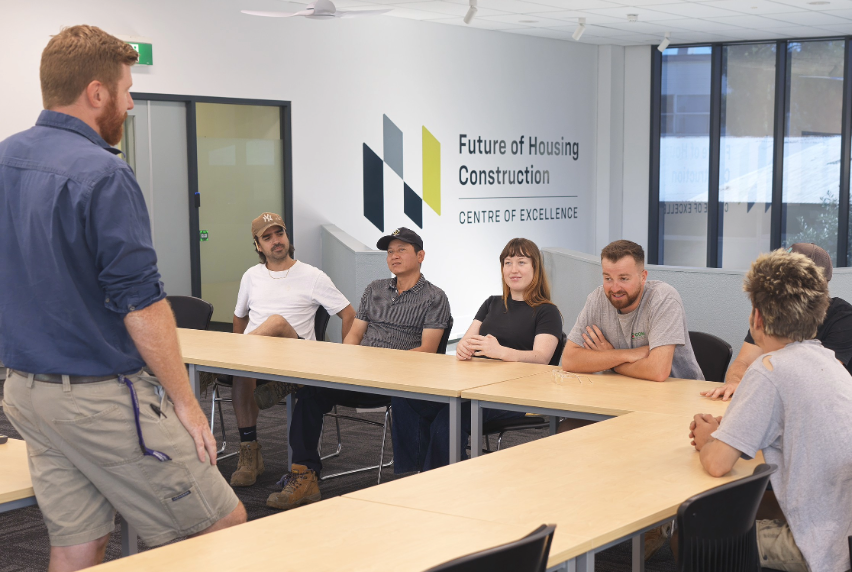
A look inside the Future of Housing Construction Centre of Excellence’s first course, introducing next-generation workers to modern methods of construction.
When Craig Battams, Vocational Trainer at Melbourne Polytechnic, stepped into the classroom to deliver the Future of Housing Construction Centre of Excellence (the Centre)’s first course, he came with a clear purpose.
“The whole reason I went down this path is because if we can build better homes – homes that use less energy, are more sustainable and last longer – then many of the pressures we’re facing, including the energy crisis, become more manageable,” Craig said, “That’s something I’ve pushed for throughout my career.”
For Craig, the Centre’s vision aligned strongly with his own longstanding belief: Australia must lift the standard of its housing.
“Australian houses, compared to global standards, especially for a developed nation, perform quite poorly in energy efficiency, lifespan and overall quality,” he said. “We have to build better.”
Designed as a three-hour introduction, ‘Rethinking Construction: Introduction to Modern Methods of Construction’ explores the history and types of modern methods of construction (MMC) to equip a new generation of tradespeople with the language and knowledge to engage and work with MMC builders; while highlighting the opportunities they present for different trades.
Built around five core principles – faster, safer, greener, smarter and better quality – the course gives apprentices a practical framework to understand how MMC technologies are reshaping the industry.
Breaking down misconceptions in modern construction
Since its launch, the course has been delivered to a range of apprentices across the industry, including carpentry, plumbing and electrical. For many, their initial perspective on MMC is shaped by uncertainty, and concepts like prefabrication, modular and volumetric construction can feel abstract or even disruptive.
“Initially, students come in seeing MMC as a threat to their jobs, the industry and their skills,” Craig said, “That’s exactly what this course is about: breaking down those misconceptions and showing what MMC actually is and where the opportunities to engage with it are.”
He emphasised that a key part of the course involves open, in-depth discussions that unpack these assumptions.
“We usually start by asking what they think MMC means, and the most common response is ‘unskilled labour’,” he said. “So, a big part of the conversation is explaining that MMC is simply a parallel industry designed to supply for a part of the market that’s currently underperforming, such as high-volume, low-quality builds.”
By connecting new technologies and processes back to familiar trade principles, Craig helps learners see that MMC is not about replacing skills, it is about evolving them.
“Think about how prefabricated roof trusses changed carpentry, or how pre-formed elbows changed plumbing,” he explained. “MMC is simply another ‘product’ designed to speed up construction, increase quality and reduce human error.
“Once students understand how it works and which parts of the market it affects, their perceptions begin to shift.”
Grounded in industry practice
Melbourne Polytechnic’s partnership with prefabAUS ensures the course remains grounded in industry reality.
“prefabAUS connects us to new players and emerging practices,” Craig said. “It helps us translate what’s happening in the industry into something practical and digestible for our students.”
As MMC evolves, so too must the curriculum.
“This isn’t a static institute,” he stressed, “It’s about staying current and responsive to what’s happening in the industry.”
“Some technologies evolve, some shift, some are abandoned, and others really take hold, so maintaining that adaptability is essential.
Building confidence for what’s next
Craig sees MMC as a practical lever to address multiple pressures facing the sector.
“It is a huge opportunity for the Australian construction industry,” Craig said, “MMC can help tackle workforce capability, housing supply and cost of living pressure.”
“While it’s not a silver bullet, it’s a strong solution to many challenges.”
Looking ahead to this year, the Centre’s focus remains clear: building future-ready skills in the next-generation workforce to address Australia’s housing challenges.
Learn more about the Future of Housing Construction Centre of Excellence.
Other events and news that may interest you

Info Tech - Jobs of the Future
Many industries are reeling from the year that was 2020. One that has exponentially risen and isn't slowing down is Information Technology.
Learn More
Bachelor of Information Technology students cap off year with real-life experience
Bachelor of Information Technology students are capping off their studies with real-world business experience.
Learn More
Bachelor of IT students create new database for Floridia Cheese
Floridia Cheese, has developed a secure milk payment system thanks to a Melbourne Polytechnic student project.
Learn More
IT graduate excellence: from Melbourne Polytechnic to Amazon Web Services
IT student Kino is awarded for his ambition, leading projects, joining committees and supporting startups.
Learn More